
The Complete Guide to Value Betting in 2026
What Is Value Betting?
Value betting is a sports betting strategy where you place bets that have a higher probability of winning than the odds suggest. When a sportsbook offers odds that underestimate the true likelihood of an outcome, that bet has positive expected value (+EV), meaning it will be profitable over time. The concept is rooted in expected value theory, a cornerstone of decision theory developed by mathematicians dating back to Pascal and Fermat in the 17th century.
Unlike traditional betting where most bettors lose money to the house edge, value bettors flip the script. They systematically find and exploit pricing errors in the betting market to generate consistent profits.
The core concept: If a coin flip (50% chance) is offered at +110 odds (implied probability 47.6%), you have value. The true probability exceeds the implied probability, making the bet +EV. Use our odds converter to translate any American, decimal, or fractional price into its implied probability.
Value betting works because:
- Sportsbooks must price thousands of markets daily
- Pricing errors are inevitable, especially in less popular markets
- Sharp bettors and market movements create temporary mispricings
- Different books have different models, creating price discrepancies (see our odds comparison tool to spot these differences)
Research from the Journal of Prediction Markets and studies published in PLOS ONE have demonstrated that betting markets, while generally efficient, contain exploitable inefficiencies, particularly before lines are sharpened by professional action.
How to Start Value Betting
Find and place positive expected value bets to generate consistent long-term profit.
- 1
Understand the concept
Value betting means placing bets where the sportsbook odds imply a lower probability than the true probability. These +EV bets profit over time through mathematical edge.
- 2
Set up sportsbook accounts
Open accounts at 10-20+ sportsbooks including both sharp (for reference odds) and soft (for value) bookmakers. More accounts mean more opportunities.
- 3
Choose your scanning tool
Subscribe to a value betting scanner that compares odds against sharp reference lines (like Pinnacle). The tool identifies bets where your sportsbook offers higher odds than the true probability.
- 4
Set your filters
Configure minimum edge percentage, preferred sports, odds range, and sportsbooks. Start with a 2%+ minimum edge to filter out marginal opportunities.
- 5
Place bets with proper staking
Use Kelly Criterion or a fixed percentage of your bankroll per bet (1-3%). Never chase losses or increase stakes after a losing streak.
- 6
Track and review performance
Log every bet and track ROI, CLV, and results by sportsbook. Review monthly to identify your strongest markets and adjust strategy accordingly.
How Value Betting Works: The Math
Understanding the mathematics behind value betting is essential. Let's break it down.
Expected Value Formula:
EV = (Probability of Winning × Potential Profit) - (Probability of Losing × Stake)
Or more simply:
EV% = (True Probability × Decimal Odds) - 1
Example calculation:
You believe the Lakers have a 55% chance to win tonight. The sportsbook offers +120 odds (decimal 2.20).
EV% = (0.55 × 2.20) - 1
EV% = 1.21 - 1
EV% = 0.21 or +21%
A 21% edge is exceptional. For every $100 wagered, you expect to profit $21 on average.
What qualifies as a value bet?
Any bet where your true probability estimate exceeds the implied probability from the odds. In practice, value bettors look for edges of 2% or higher to account for uncertainty in probability estimates.
The role of the vig:
Sportsbooks build in a margin (vig or juice) on every market. Standard -110/-110 odds on a 50/50 proposition have about 4.5% vig. Value bets must overcome this margin to be profitable. Use our no-vig calculator to remove the margin from any line and see the true implied probability.
Finding Value Bets: Manual vs Software
There are two approaches to finding value bets: building your own models or using software that identifies them automatically.
Manual Value Betting
Building your own projection model means:
- Collecting relevant data (team stats, injuries, weather, etc.)
- Creating a model that outputs win probabilities
- Comparing your probabilities to bookmaker implied probabilities
- Betting when your probability significantly exceeds theirs
Pros of manual value betting:
- Deeper understanding of the markets
- Potential for unique edges others miss
- No subscription costs
Cons of manual value betting:
- Extremely time-intensive
- Requires statistical expertise
- Limited to sports/markets you can model
- Can't scale across hundreds of markets
Software-Based Value Betting
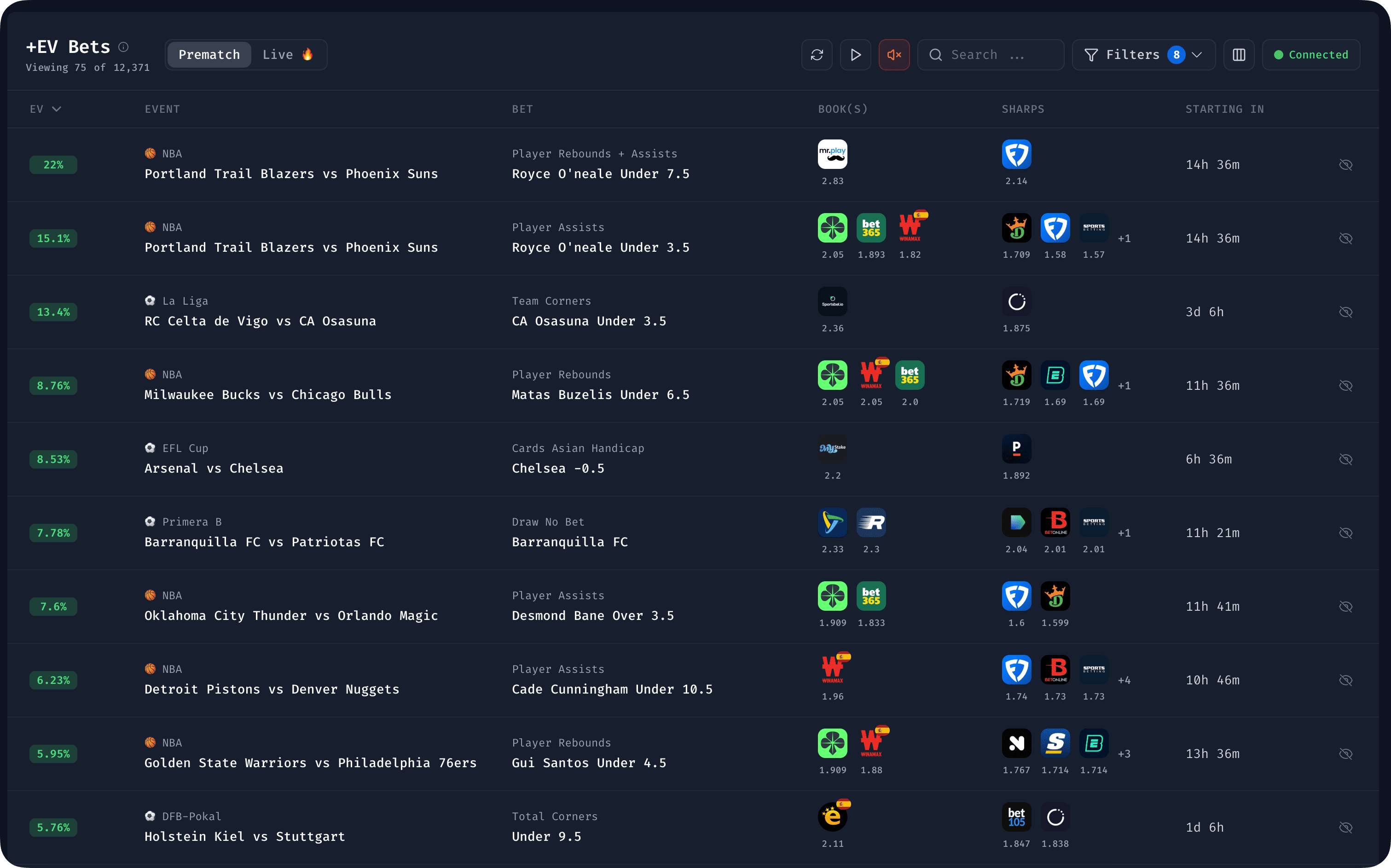
Value betting software scans odds across many sportsbooks, compares them to sharp market consensus, and identifies when retail books are offering inflated odds.
The approach: Sharp books like Pinnacle have the most accurate odds because they accept professional bettors. When a retail book offers significantly better odds than Pinnacle, that's likely a value bet.
Pros of software:
- Scans thousands of markets in seconds
- No modeling expertise required
- Works across all sports automatically
- Identifies opportunities 24/7
Cons of software:
- Monthly subscription cost
- Dependent on software quality
- You're betting on the same opportunities as other users
For most bettors, software is the practical choice. Manual modeling is viable for those with deep expertise in specific sports, but it's not scalable.
Our value bet scanner compares odds across 400+ sportsbooks in real-time, highlighting opportunities where retail books offer prices that beat the sharp market consensus.
How to Start Value Betting: Step by Step
Step 1: Set Up Your Bankroll
Decide how much money you're willing to dedicate to value betting. This should be money you can afford to lose during the inevitable downswings.
Recommended starting bankroll: $1,000-5,000 minimum. Less than this makes the variance difficult to manage and limits your ability to place optimally-sized bets.
Step 2: Open Multiple Sportsbook Accounts
Value betting requires access to many books because:
- Different books have different odds
- You need to bet wherever the value appears
- Spreading action reduces limiting risk
Start with 5-10 accounts at major retail sportsbooks in your region. Fund each with a portion of your bankroll.
Step 3: Choose Your Value Betting Method
Either build your own models (advanced) or subscribe to value betting software (recommended for most).
If using software, look for:
- Real-time odds comparison
- Clear EV% display
- Filtering by sport, odds range, and EV threshold
- Kelly criterion staking suggestions
- Track record and user reviews
Step 4: Configure Your Filters
Not all value bets are equal. Configure your approach:
- Minimum EV%: Start with 2%+ to ensure meaningful edge
- Odds range: Higher odds have more variance; 1.5-3.0 is a good starting range
- Sports: Stick to major sports initially (NFL, NBA, soccer, tennis). For sport-specific strategies, see our NBA value betting guide
- Markets: Sides and totals are most reliable; props have higher variance
Step 5: Start Betting
When a value bet appears:
- Verify the odds are still available
- Calculate your stake using Kelly criterion
- Place the bet before odds change
- Record the bet in your tracking system
Speed matters. Value bets can disappear in seconds as lines move.
Step 6: Track Everything
Record every bet with:
- Event and market
- Odds when placed
- Stake
- EV% at time of bet
- Closing line (odds just before event starts)
- Result
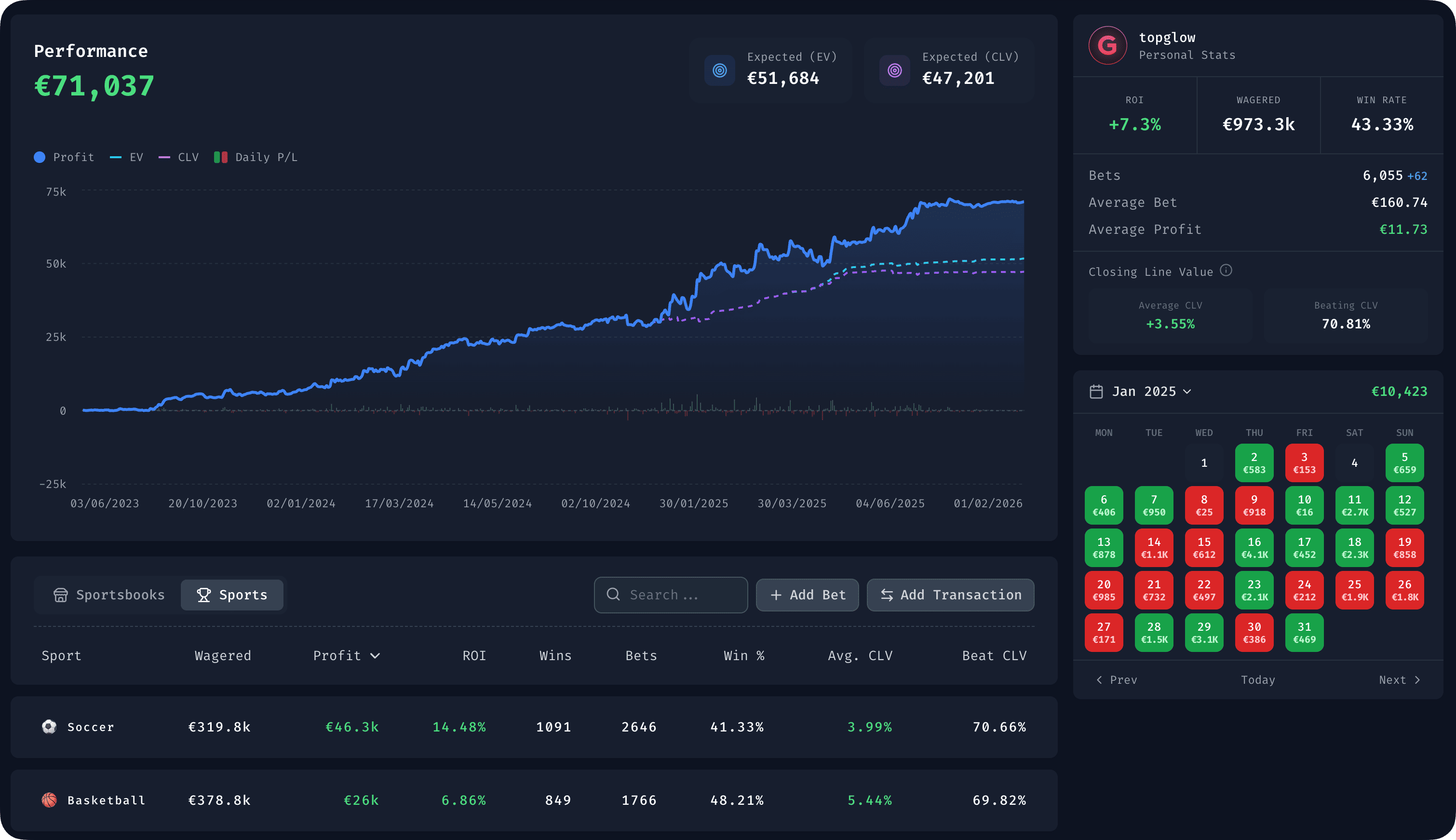
Tracking lets you analyze performance and verify you're actually beating the market.
Our bet tracker automatically logs your bets and calculates closing line value, ROI, and other key metrics.
Bankroll Management for Value Betting
Proper bankroll management is critical. Even with edge, poor staking can lead to ruin.
The Kelly Criterion
The Kelly criterion calculates optimal bet size based on your edge and the odds:
Kelly % = (bp - q) / b
Where:
- b = decimal odds - 1
- p = probability of winning
- q = probability of losing (1 - p)
Example:
You have a 55% edge on +120 odds (decimal 2.20):
- b = 1.20
- p = 0.55
- q = 0.45
Kelly % = (1.20 × 0.55 - 0.45) / 1.20
Kelly % = (0.66 - 0.45) / 1.20
Kelly % = 0.175 or 17.5%
Full Kelly says bet 17.5% of your bankroll. In practice, this is too aggressive.
Fractional Kelly
Most value bettors use fractional Kelly to reduce variance:
- Half Kelly (50%): Most common recommendation
- Quarter Kelly (25%): Very conservative, smoother growth
- Eighth Kelly (12.5%): Ultra-conservative
For the example above:
- Full Kelly: 17.5% of bankroll
- Half Kelly: 8.75%
- Quarter Kelly: 4.375%
Why fractional Kelly?
- Your probability estimates have uncertainty
- Reduces drawdown severity
- Accounts for correlated bets
- Preserves bankroll during losing streaks
Practical staking rules:
- Never bet more than 5% of bankroll on a single bet
- Adjust stake based on confidence in the edge
- Resize stakes as bankroll grows/shrinks
- Don't chase losses with larger bets
Our Kelly criterion calculator helps you determine optimal stake sizes based on your bankroll and the edge on each bet.
Understanding Variance in Value Betting
Variance is the difference between expected results and actual results. Even with edge, you will have losing days, weeks, and sometimes months.
Why variance matters:
A +5% EV bet still loses 45-48% of the time. String together several losses, and your bankroll can drop significantly before the edge manifests.
Visualizing variance:
Imagine flipping a coin that lands heads 55% of the time (you have 5% edge). In 100 flips:
- Expected: 55 heads
- Possible range: 40-70 heads is common
- Extreme: Could see 35 or 75 heads
The same applies to betting. Even with real edge, short-term results vary widely.
Dealing with downswings:
- Trust the process: If your CLV is positive, you have edge. Results follow eventually.
- Don't increase stakes: Chasing losses destroys bankrolls
- Review your data: Ensure you're actually betting +EV opportunities
- Manage emotions: Variance is mathematical, not personal
- Have sufficient bankroll: Underfunding makes normal variance feel catastrophic
How long until results normalize?
Value betting requires volume. Statistical significance typically requires:
- 500-1,000 bets minimum to see trends
- 2,000-5,000 bets for reliable performance data
- Months of consistent betting
This is why tracking and patience are essential. Short-term results are noise; long-term results reveal your true edge.
For more on handling the emotional and mathematical aspects of variance, see our guide on variance in sports betting.
Closing Line Value: The True Measure of Skill
Closing Line Value (CLV) is the most important metric for value bettors. It measures whether you're consistently beating the market.
What is CLV?
CLV compares the odds you bet to the closing odds (the final odds before the event starts). The closing line is considered the most efficient because it incorporates all available information.
Example:
- You bet Lakers -3 at -105
- The line closes at Lakers -3.5 at -110
- You got CLV because you bet a better line
Why CLV matters more than win rate:
You can win bets and still have negative CLV (lucky). You can lose bets and have positive CLV (unlucky but skilled).
Over thousands of bets, positive CLV is the strongest indicator of long-term profitability. It proves you're systematically finding value before the market corrects. The Smart Betting Club audited 16,488 real Bet Hero bets on exactly this basis; the numbers are in our Bet Hero review.
Target CLV:
- +2% CLV average: Good, sustainable edge
- +3-5% CLV average: Excellent
- +5%+ CLV average: Exceptional, but likely to attract limiting
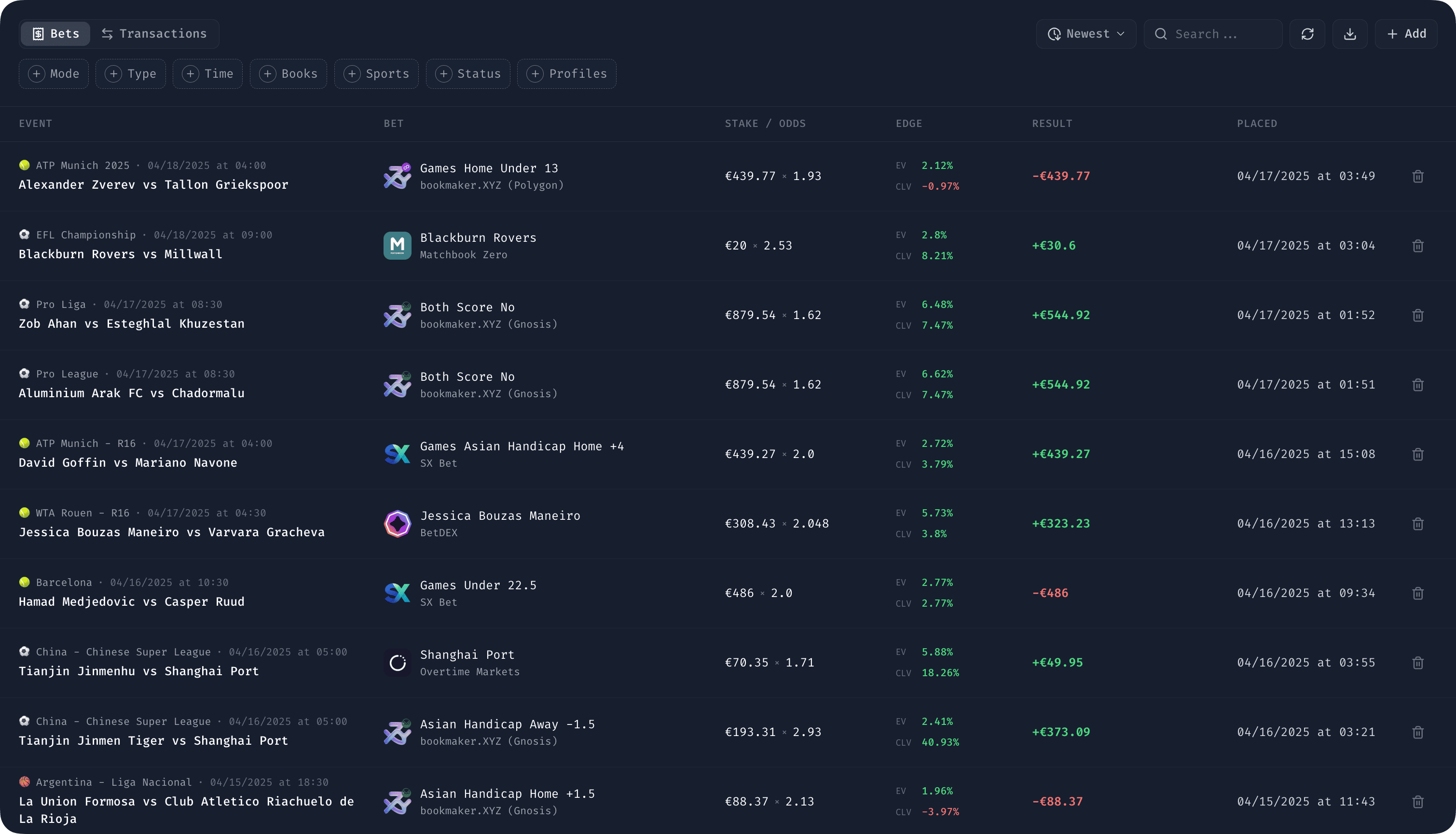
Tracking CLV:
Our bet tracker automatically calculates CLV for every bet, showing you whether you're genuinely beating the market or just running hot.
For a deep dive, read our complete guide on closing line value explained.
Account Limitations and How to Delay Them
The uncomfortable truth: sportsbooks don't want winning bettors. If you're successful, you'll eventually face limitations.
What limiting looks like:
- Maximum bet sizes reduced (from $500 to $10)
- Odds offered worse than advertised
- Account restricted to certain markets
- Complete account closure
Why books limit winners:
Retail sportsbooks profit from recreational losers. Sharp bettors who consistently win are unprofitable customers. It's business, not personal.
Strategies to delay limiting:
1. Bet round numbers
- Bet $50, $100, $200 rather than $147.32
- Kelly criterion suggests precise amounts; round them
2. Don't bet immediately after line releases
- Betting the opening line signals sharp behavior
- Wait 15-30 minutes after lines post
3. Avoid exclusively betting +EV
- Occasional recreational bets provide cover
- Small parlays, player props, futures
4. Spread action across books
- Don't hammer one book repeatedly
- Rotate which books you bet based on value
5. Use multiple accounts (legally)
- Family members' accounts (with permission)
- Different licensed books in your jurisdiction
6. Don't withdraw constantly
- Frequent withdrawals flag sharp bettors
- Let balances sit occasionally
7. Take advantage of promotions
- Recreational bettors use promos
- Makes your account look normal
8. Avoid sharp markets exclusively
- Betting only sides and totals signals sharpness
- Mix in some props and futures
When you get limited:
- Open accounts at new books
- Focus on sharp-friendly books (Pinnacle, Circa, Bookmaker)
- Consider betting exchanges (Betfair) where commission gets factored into the effective price
- Adjust strategy to maximize remaining accounts
For more strategies, see our detailed guide on how to avoid sportsbook limits.
Value Betting vs Arbitrage Betting
Both strategies exploit market inefficiencies, but they work differently.
Value Betting:
- Single bets with positive expected value
- Some bets lose, profit comes from edge over time
- Higher potential returns
- Requires volume and patience
Arbitrage Betting:
- Bet both sides across different books for guaranteed profit
- Every bet profits regardless of outcome
- Lower returns per bet (typically 1-3%)
- Faster, more consistent income
Which is better?
| Factor | Value Betting | Arbitrage |
|---|---|---|
| Risk | Higher (variance) | Lower (guaranteed) |
| Return potential | Higher | Lower |
| Account limiting | Moderate | Severe |
| Capital requirement | Lower | Higher |
| Time investment | Lower | Higher |
Verdict: Value betting offers better long-term returns but requires handling variance. Arbitrage is safer but gets limited faster and requires more capital across books.
Where each one bites:
- Arbitrage risk is execution, not results. A properly placed arb can't lose, but one leg can move before you place the second, and a book can void a bet it calls a pricing error. Place the less liquid side first.
- Arbitrage needs money spread wide. Each book has to hold enough to stake its side, and funds sit locked until both legs settle.
- Value betting risk is variance. A bet at 5% EV still loses close to half the time on even-money prices, and losing weeks are normal. You have to trust the math through them.
- Arbitrage gets noticed faster. Betting only when prices diverge, in exact stakes, on both sides within minutes, is an easy pattern for a book to spot. Single value bets look more like an ordinary customer.
Which fits you? If your capital is modest, your time is limited to evenings, and you can sit through a losing run, start with value betting. If you'd rather have steady, predictable returns and can fund a dozen or more books and watch the scanner through the day, arbitrage suits you better. Many bettors end up using both: arbitrage for consistent base income, value betting for growth, shifting capital to value bets as arb accounts get limited. On the arb side, plug any opportunity into our arbitrage calculator to see the exact stake split.
We cover both strategies: value bets for +EV opportunities and surebets for arbitrage.
Common Value Betting Mistakes
1. Insufficient sample size
Judging your edge after 50 bets is meaningless. Variance dominates at small sample sizes. Commit to 1,000+ bets before drawing conclusions.
2. Chasing losses
After a losing streak, the temptation is to increase stakes to recover quickly. This is how bankrolls die. Stick to your staking plan regardless of recent results.
3. Betting stale lines
Value bets disappear quickly. If you see a +5% EV bet and take 30 seconds to place it, the line may have moved. Speed matters.
4. Ignoring Kelly criterion
Betting the same amount on every play ignores edge size and odds. A 10% EV bet deserves more stake than a 2% EV bet. Let Kelly (fractional) guide your sizing.
5. Over-concentrating on one book
Hammering your best odds repeatedly gets you limited fast. Spread action across many accounts, even if it means occasionally taking slightly worse odds.
6. Neglecting tracking
Without data, you can't verify edge, identify weaknesses, or prove to yourself that the strategy works. Track every bet meticulously.
7. Emotional reactions to variance
A bad week doesn't mean the strategy is broken. A great week doesn't mean you're a genius. Results are noisy. Focus on process (CLV) over outcomes.
8. Betting beyond your bankroll
If losing 10 bets in a row would devastate you financially or emotionally, your stakes are too high. Bet amounts you can handle losing.
Value Betting Results: What to Expect
For detailed performance data, see our value betting results breakdown with real tracked outcomes.
Realistic expectations:
With disciplined value betting and proper bankroll management:
- Monthly ROI: 2-10% of bankroll
- Annual ROI: 20-100%+ depending on volume and edge
- Downswings: Expect 10-20% bankroll drops periodically
Factors affecting results:
- Edge size: Higher average EV means faster growth
- Bet volume: More bets = faster realization of edge
- Odds range: Higher odds = more variance
- Markets bet: Some sports/markets have more edge than others
- Limiting: Getting limited reduces opportunity
Sample growth trajectory:
Starting bankroll: $2,000 Monthly volume: 300 bets Average EV: 3%
After 1 year with half Kelly and no limiting:
- Expected profit: $2,000-4,000
- Range of outcomes: Break-even to $6,000+ profit
This isn't get-rich-quick. It's methodical, math-based investing in sports betting markets.
Tools You Need for Value Betting
Essential:
- Value bet finder - Software that identifies +EV opportunities
- Multiple sportsbook accounts - Access to place bets where value exists
- Bet tracker - Record bets, calculate CLV, analyze performance
- Bankroll management system - Know your stakes and limits
Helpful:
- EV calculator - Verify edges manually when needed
- Kelly criterion calculator - Determine optimal stake sizes
- Odds converter - Convert between American, decimal, fractional
Our tools:
- Value Bet Scanner - Real-time +EV opportunities across 400+ books
- Arbitrage Finder - Guaranteed profit opportunities
- Bet Tracker - Log bets, see ROI by sport and book, and get CLV on scanner bets
- EV Calculator - Calculate expected value for any bet
- Kelly Calculator - Optimal stake sizing
Key Takeaways
- Value betting exploits pricing errors where odds underestimate true probability
- Expected value (EV) is calculated as (probability × odds) - 1
- Use software to scan markets or build your own models for specific sports
- Kelly criterion (fractional) determines optimal stake sizes
- Bankroll management is essential to surviving variance
- CLV (closing line value) is the true measure of betting skill
- Expect limiting eventually; spread action and use sharp-friendly books
- Track everything to verify edge and improve over time
- Volume matters: 1,000+ bets needed for meaningful conclusions
- Realistic returns: 2-10% monthly ROI with proper execution
Value betting transforms sports betting from gambling into a calculated investment strategy. With the right tools, discipline, and patience, it's one of the most reliable ways to generate consistent returns from sports markets.
Ready to start? Our value bet scanner identifies +EV opportunities in real-time across 400+ sportsbooks. Sign up and start finding edge today.
Frequently Asked Questions
What is value betting?
Is value betting legal?
How much money can you make value betting?
How long does it take to see profits from value betting?
Which sports are best for value betting?
Do sportsbooks limit value bettors?
What EV% should I target?
Should I use value betting software?
Related Calculators

Juan Sebastian Brito is the CEO and Co-Founder of Bet Hero, a sports betting analytics platform used by thousands of bettors to find +EV opportunities and arbitrage. With a background in software engineering and computer science from FIB (Universitat Politècnica de Catalunya), he built Bet Hero to bring data-driven, mathematically-proven betting strategies to the mainstream. His work focuses on probability theory, real-time odds analysis, and building tools that give bettors a quantifiable edge.
View all articles →Put this into practice
Bet Hero scans 400+ sportsbooks in real-time to find +EV bets and arbitrage opportunities so you don't have to.
Keep reading
How Sharp Bettors Find Value (And How You Can Too)
Learn the exact methods professional sports bettors use to find +EV opportunities. From no-vig calculations to CLV tracking, here's how sharps actually win.
How to Bet on the World Cup: A Value Bettor's Guide
How to bet on the World Cup like a sharp: which markets are soft, where casual money creates value, and how to devig sharp lines to find +EV across the tournament.