
How to Track Your Bets: The Foundation of Profitable Betting
Why Most Bettors Don't Track (and Why That's a Problem)
Ask a casual bettor their lifetime ROI. They'll say "I'm probably about even" or "I'm up a bit."
Ask them for proof. They can't provide it.
The uncomfortable truth: without tracking, you have no idea if you're winning or losing. Memory is unreliable. We remember the big wins, forget the steady losses.
Professional bettors track every single bet. It's not optional. It's the foundation everything else builds on.
How to Track Your Sports Bets
Set up a systematic bet tracking system to analyze your performance and improve your strategy.
- 1
Choose a tracking method
Select a dedicated bet tracker tool, spreadsheet, or app. Dedicated tools like Bet Hero's bet tracker automatically calculate ROI, CLV, and other key metrics.
- 2
Record essential bet details
For each bet, log the date, sport, event, bet type, odds, stake, sportsbook, and result. Include the closing line odds if tracking CLV.
- 3
Track key performance metrics
Monitor your ROI, CLV, win rate, and profit by sport/market/sportsbook. These metrics reveal where your edge is strongest and where you need improvement.
- 4
Review and analyze regularly
Review your tracked bets weekly or monthly. Look for patterns in your most and least profitable markets, and adjust your strategy based on the data.
What to Track for Every Bet
At minimum, record these fields for each bet:
Essential:
- Date and time
- Sport and league
- Event (teams/players)
- Bet type (spread, total, moneyline, prop)
- Your odds
- Stake amount
- Sportsbook used
- Result (win/loss/push)
- Profit/loss
Advanced (highly recommended):
- Closing line odds (for CLV calculation)
- Your edge estimate at time of bet (use our EV calculator to calculate this)
- Reasoning/notes
- Market (where you found the bet)
Why closing line matters:
CLV (Closing Line Value) is the best predictor of long-term success. If you consistently beat the closing line, you're making +EV bets even if short-term results are rough.
Our bet tracker records CLV automatically for prematch bets you track from the value bet scanner, so you can measure this without manual effort. For any other bet, the CLV calculator does it in seconds.
Choosing a Tracking System
Bet Hero's Free Tracker (Recommended)
Our bet tracker is built specifically for +EV and arbitrage bettors:
- CLV on scanner bets - Prematch bets tracked from the value bet scanner (paid plans) get their closing line recorded automatically
- ROI breakdown by sport and sportsbook, with filters for bet type, status and date range
- Visual P/L dashboard with performance charts over time
- Sportsbook balance tracking across all your accounts
- Transaction history for deposits and withdrawals
- One-click tracking from our +EV scanner - find a bet, track it instantly
- Completely free
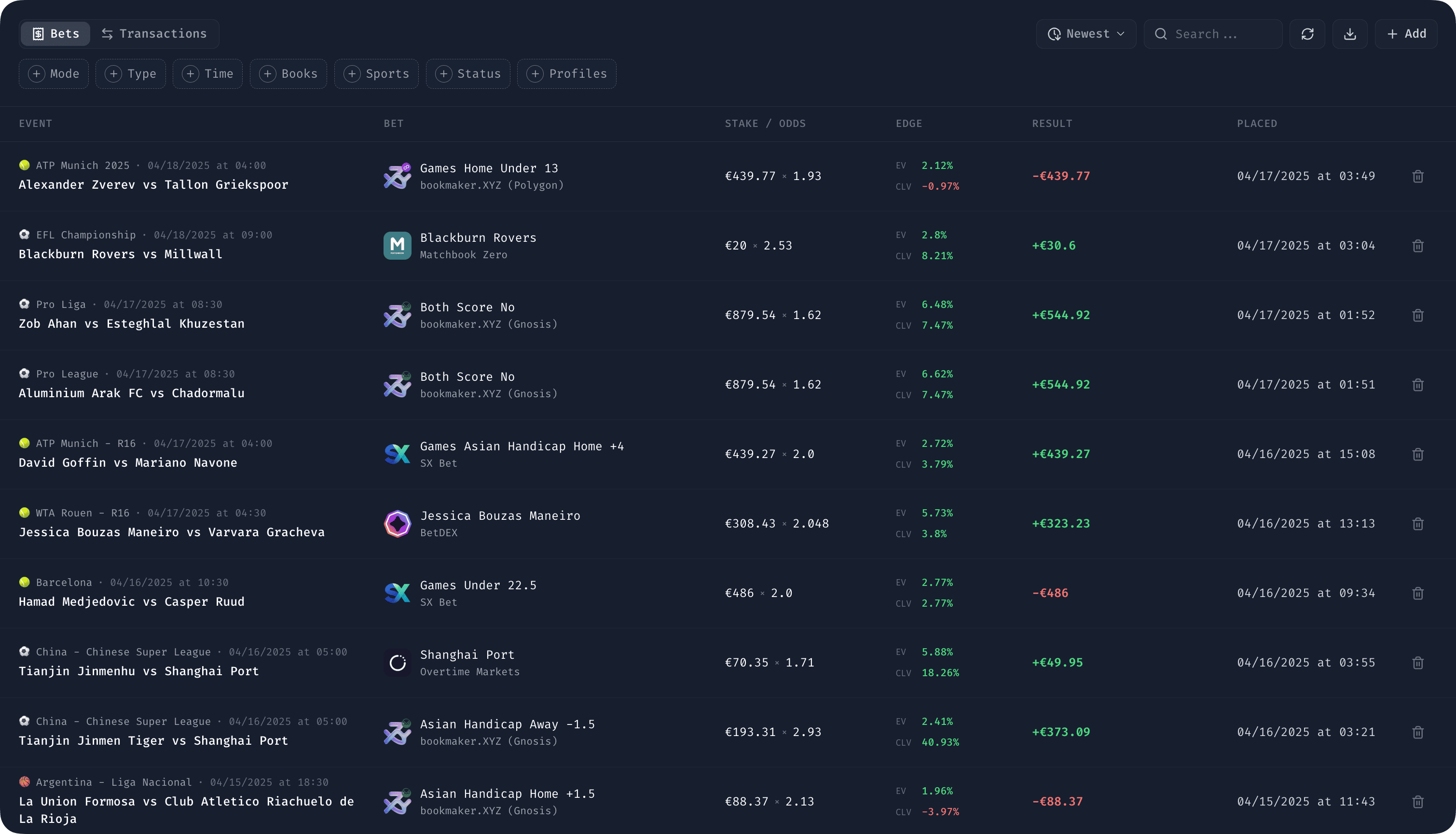
The integration with our value bet scanner is the key advantage. When you find a +EV opportunity, you can track it with one click. The closing line is recorded automatically, so you always know your true CLV without extra work.
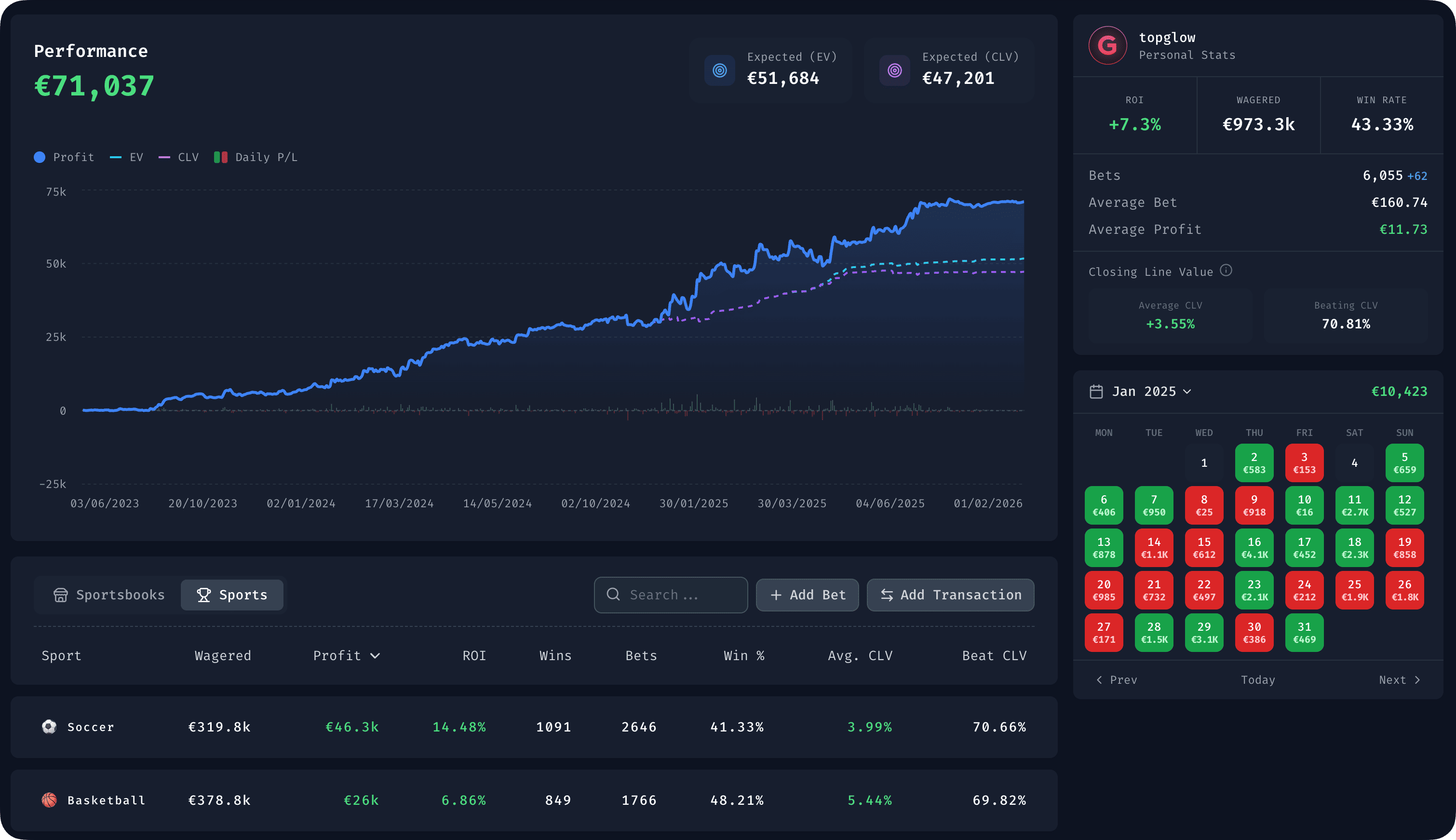
Other Options
Pikkit - A popular mobile-first bet tracker with a clean interface. Good for bettors who want to log bets on the go. Offers basic analytics and P/L tracking.
Spreadsheets (Google Sheets/Excel) - Free and fully customizable, but manual entry is tedious and CLV tracking requires checking closing lines yourself. Works for low-volume bettors (under 50 bets/month) but becomes unsustainable at higher volumes.
Other paid trackers - Various options exist with different feature sets. Most charge monthly fees and may not integrate with your bet-finding tools.
Setting Up Your Tracking System
Step 1: Sign up for a tracker
Create your Bet Hero account to access the bet tracker. If you're already using our +EV scanner, the tracker is built right in.
Step 2: Track from day one
Don't wait until you're "ready." Start tracking immediately. Every untracked bet is lost data.
Step 3: Be religious about entry
Enter bets immediately after placing them, or at least daily. Backfilling from memory corrupts your data.
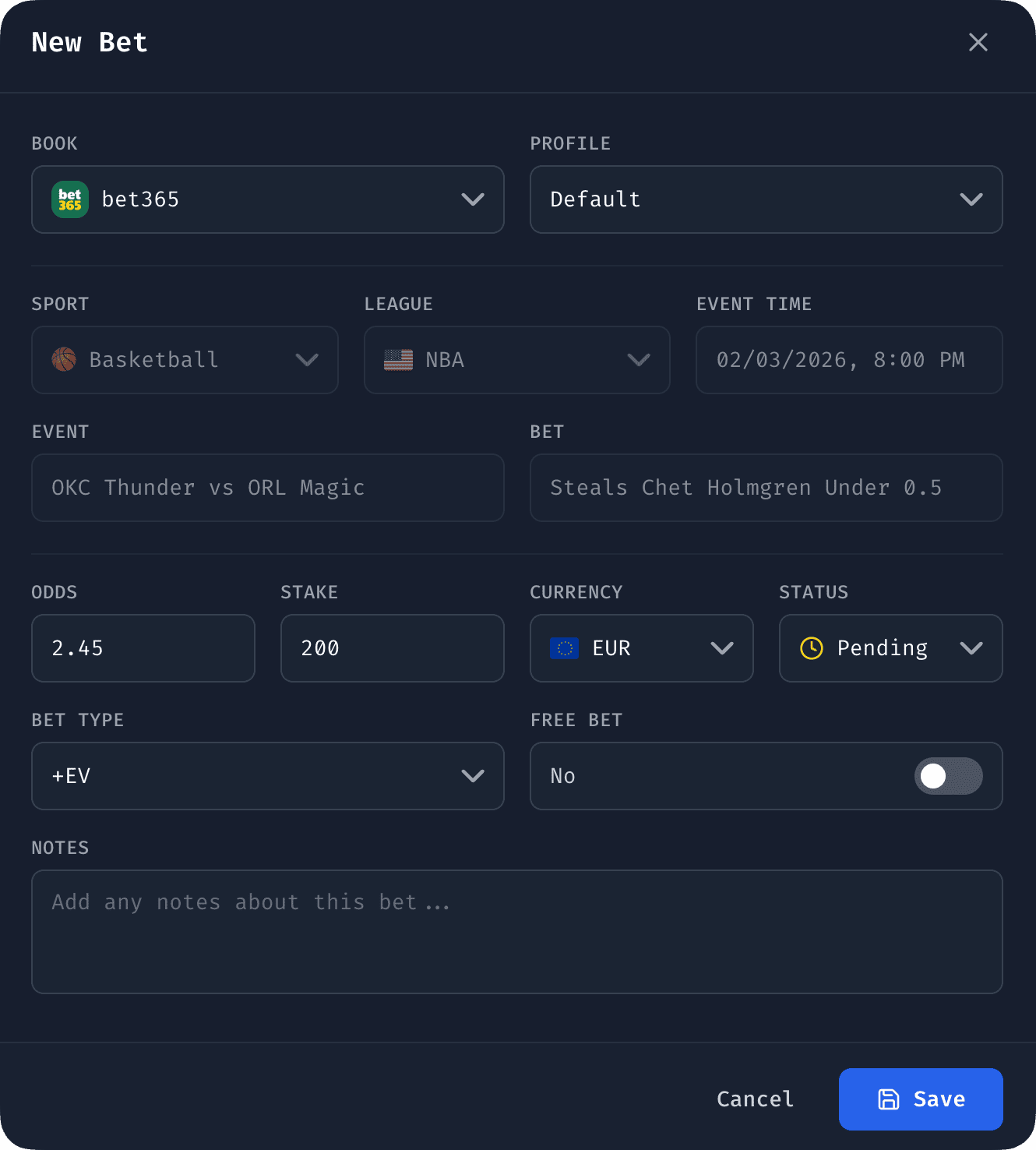
Step 4: Record closing lines
This is the step most bettors skip. Set a reminder to check closing odds 5 minutes before each game. Or use software that does it automatically.
Analyzing Your Data
Once you have 100+ bets tracked, start analyzing:
Basic metrics:
- Total P/L (are you up or down?)
- ROI (profit / total wagered)
- Win rate (wins / total bets)
Intermediate metrics:
- ROI by sport (where are you best?)
- ROI by bet type (spreads vs. totals vs. props)
- ROI by sportsbook
- Average stake sizing
Advanced metrics:
- Average CLV (are you beating closing lines?)
- CLV by sport/bet type
- Expected profit vs. actual profit
- Variance from expectation
What Your Data Tells You
Scenario 1: Positive ROI, Positive CLV
You're doing well. Your edge is real and sustainable. Continue your strategy.
Scenario 2: Negative ROI, Positive CLV
You're running bad but betting correctly. Variance is against you. Stay the course; your process is sound.
Scenario 3: Positive ROI, Negative CLV
You're running hot but betting poorly. This is unsustainable. You need to fix your bet selection.
Scenario 4: Negative ROI, Negative CLV
Your strategy isn't working. Re-evaluate your edge identification and bet selection process.
CLV is more predictive than short-term ROI. A bettor with negative ROI but positive CLV is in better shape than the reverse.
Common Tracking Mistakes
1. Tracking only some bets
Cherry-picking which bets to track makes your data worthless. Track everything.
2. Not tracking losing days
It's tempting to skip tracking after a brutal day. Don't. That's the most important data.
3. Rounding or estimating
"I think I bet like $50" isn't good enough. Record exact amounts.
4. Forgetting to record closing lines
This is the most common mistake. Without closing line data, you can't calculate CLV.
5. Not categorizing properly
"NFL" isn't specific enough. Track league, bet type, and market. The more granular, the more useful your analysis.
Using Tracking to Improve
Your tracking data reveals where to focus:
If your prop bet ROI is +8% but spread ROI is -3%: Focus more on props. You have edge there.
If your NBA ROI is +5% but NFL ROI is -2%: Maybe you understand basketball better. Lean into your strength.
If your CLV is best on bets placed Sunday morning: You're finding value in fresh lines. Make sure you're available Sunday mornings.
If your ROI craters on bets above $100: You might be chasing or overconfident on certain games. Use a Kelly Criterion calculator to determine optimal stake sizes based on your edge, and stick to consistent sizing.
How Often to Review
- Weekly: Quick P/L check, ensure data is current
- Monthly: ROI by category, CLV trends, identify patterns
- Quarterly: Deep analysis, strategy adjustments, compare to goals
Don't over-analyze after every session. Small samples mean nothing. But regular reviews catch problems before they compound.
Integrating Tracking with Bet Selection
The best tracking systems connect to your bet finding process:
- Find +EV bet via scanner or research
- Record the bet and expected edge
- Place the bet
- Track closing line automatically
- Record result
- Analyze whether your edge estimation was accurate
This closed loop improves your bet selection over time. You learn which opportunities consistently deliver edge and which ones are fool's gold.
Don't Forget: Track Your Transactions
Bet tracking is only half the picture. You also need to track deposits and withdrawals across all your sportsbooks.
Why transaction tracking matters:
- Know your true bankroll: Without tracking deposits and withdrawals, you don't know how much you've actually invested or withdrawn
- Spot funding issues: See which books are draining capital vs. accumulating profits
- Rebalance intelligently: Know when to move money between books
- Tax reporting: Clear records of all money movement simplifies tax time
Our transaction tracker lets you log every deposit and withdrawal with the sportsbook, amount, date, and payment method.
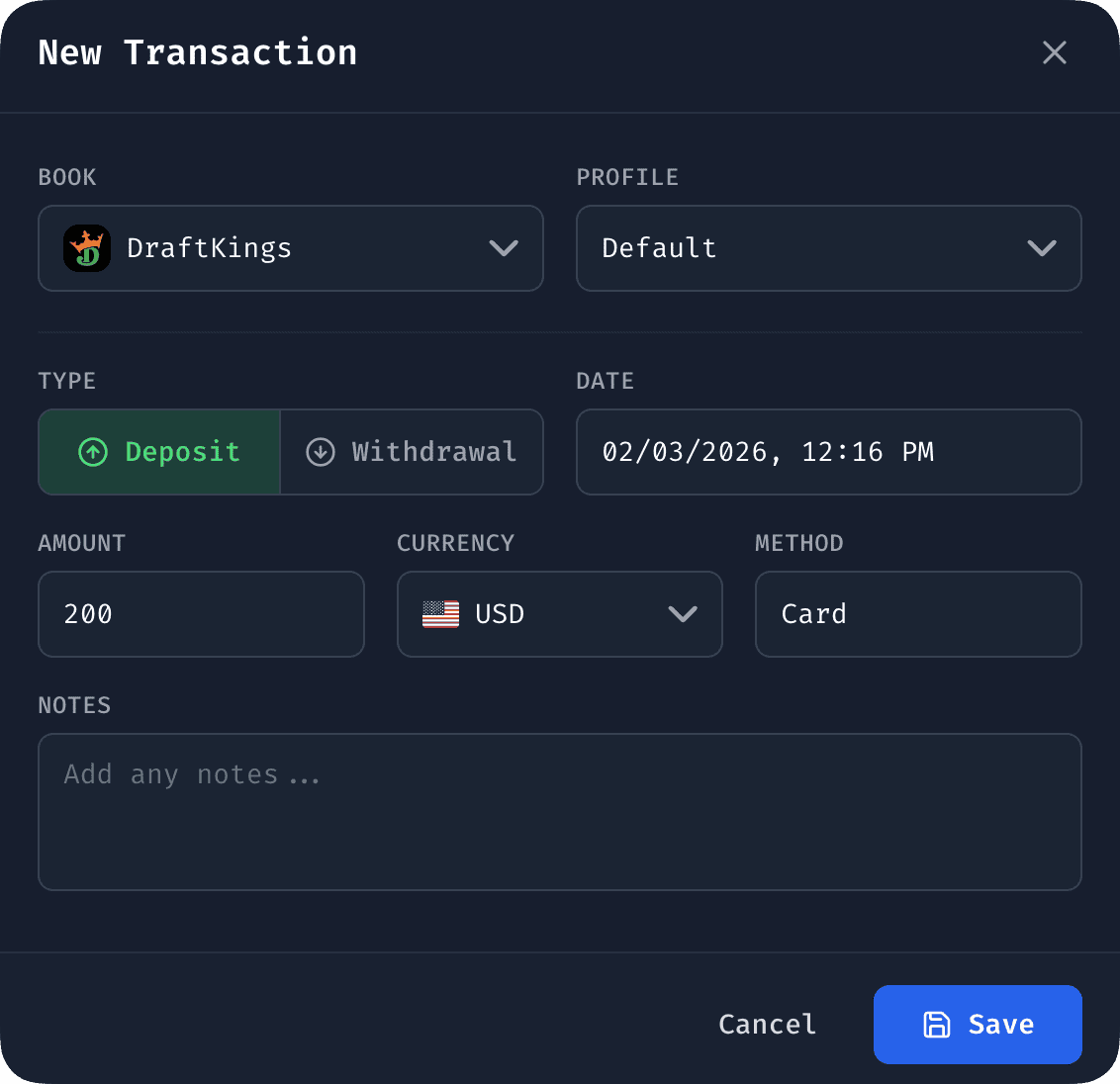
Best practice: Log transactions immediately. When you deposit $200 at DraftKings, record it before you place your first bet. When you withdraw, log it the same day.
Key Takeaways
- Track every bet; memory is unreliable and biased
- Record closing lines to calculate CLV, the best measure of edge
- Track transactions too; deposits and withdrawals complete the picture
- Use Bet Hero's free tracker for free analytics, and one-click tracking with automatic CLV from our +EV scanner
- Analyze ROI and CLV by category to find where your edge comes from
- Don't over-analyze small samples; wait for 100+ bets minimum
- CLV beats ROI as a predictor of long-term success
- Review weekly for data hygiene, monthly for trends, quarterly for strategy
- Tracking isn't optional; it's the foundation of professional betting
Frequently Asked Questions
What should I track for every bet?
Why is closing line value (CLV) important to track?
How many bets do I need before analyzing my results?
Should I use a spreadsheet or betting tracker app?
How often should I review my betting data?
What's the biggest tracking mistake bettors make?
Related Calculators

Juan Sebastian Brito is the CEO and Co-Founder of Bet Hero, a sports betting analytics platform used by thousands of bettors to find +EV opportunities and arbitrage. With a background in software engineering and computer science from FIB (Universitat Politècnica de Catalunya), he built Bet Hero to bring data-driven, mathematically-proven betting strategies to the mainstream. His work focuses on probability theory, real-time odds analysis, and building tools that give bettors a quantifiable edge.
View all articles →Put this into practice
Bet Hero scans 400+ sportsbooks in real-time to find +EV bets and arbitrage opportunities so you don't have to.
Keep reading
Bet Tracking Spreadsheet vs. Dedicated Tracker (2026 Guide)
Compare bet tracking spreadsheets against dedicated trackers. See what to track, common spreadsheet mistakes, and why most serious bettors switch to software.
Line Shopping: The Easiest Way to Increase Your Betting Profits
Learn why line shopping is essential for profitable betting. Compare odds across sportsbooks to find the best price on every bet and boost your ROI instantly.